GOD AND THE HAIYAN

There is no two same natural disasters but the question on 'why did this terrible, terrible thing happened to me?' is the one asked by all those who underwent the onslaught of natural or rather, 'God engineered' disasters anywhere in the world, be it the 2004 tsunami or earlier this week, the typhoon Haiyan.
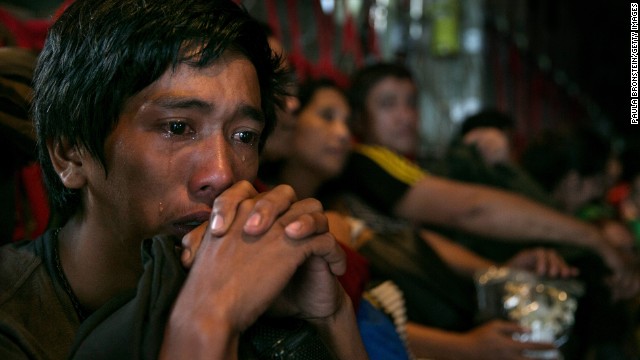
A man sits crying on a packed aircraft in Tacloban on November 12.
In the days that followed the typhoon's deadly strike, survivors frantically search for missing loved ones and international aid organizations are doing their best to atone the desperate and horrific plight of the people of the Philippines.
So far, humans are left to help themselves.

Residents carry bags of rice from a Tacloban warehouse that they stormed November 11 because of a food shortage.
As death toll climbs to 10,000 in the heavily Catholic country, many disillusioned and desolate people are asking,"How should we make sense of such senseless deaths and destruction?"
As the Bible hints, that God is in the whirlwind itself and Him being present in the aftermath of Haiyan or any natural disasters in the form of the people who mobilize to provide for the people who have practically lost everything, perhaps even their faith in God.
But, such happenings either strengthen the belief in god or shatters the belief in god in people, depending on how such disasters 'treat' them.
These questions of 'why' may not be new, but we keep asking them, perhaps because the answers remain so elusive.
A paradox sits at the epicenter of Americans, over their thinking about natural disasters. 56% of Americans believe that god is in control of everything, being omniscient.
But, according to a 2011 poll by the Public Religion Research Institute, more Americans blame hurricanes, earthquakes and other storms on global warming (58%) than on a wrathful and punishing deity (38%).
These kind of questions about God being in control and there simultaneously being suffering are the kind of things that keep seminarians up at night.
Thorny theological issues they are, contained in sensitivity.
The Bible's Psalm 107 says that “For (God) commands, and raises the stormy wind, which lifts up the waves thereof. ... He turns rivers into a wilderness, and the water springs into dry ground."
But, most Americans have moved past the idea that God causes natural disasters.
When it comes to earthquakes and hurricanes, the assessing authorities are geologists and meteorologists and they are predominantly American.  
Most Americans now interpret these events not through the rumblings of the biblical prophet Jeremiah or the poetry of the Book of Revelation but through the scientific truths of air pressure, seismic activity and tectonic plates.
 Author and activist Sam Harris said that for atheists, storms like Haiyan are proof that God does not exist.
"Either God can do nothing to stop catastrophes like this, or he doesn’t care to, or he doesn’t exist. God is either impotent, evil or imaginary," Harris said after Japan's tsunami. "Take your pick, and choose wisely."
God could or could not be in withering storms but numerous religious leaders say that a perceived celestial presence in the wake of such turbulence as people help each other.
Rabbi Harold Kushner, author of the bestselling book "When Bad Things Happen to Good People," describes in his book why a good God would allow bad things to take place, calling nature 'an equal-opportunity destroyer', making no discrimination. 

A body lies amid the Tacloban devastation on November 10.
Kushner said that he sees God's hand in the resilience of people whose lives have been destroyed and in the "goodness and generosity" of strangers who donate and pray for the survivors.
Rev. James Martin, a Jesuit priest and best-selling author, said that there is no good answer as to why humans suffer, sometimes terribly in the first place.
"Each person has to come to terms with that," Martin said. "It’s not as if some magic answer can be found. But the idea of God suffering along with us can be very helpful."
Hinduism says karma is behind all this suffering and catastrophes. Sins committed in previous incarnations will be paid for in this birth and it is a cycle. The only way to escape this rebirths and recurring suffering, is to surrender oneself completely to God and unite with the divinity in Moksha (nirvana) by the soul which is indestructible and no more assuming births.
On the other hands, Muslims see natural disasters as tests from God. They believe that God tests those he loves and these tragedies is God's way to remind them to be grateful for all of our blessings and sentient that they must support those who are less fortunate.
From the Buddhism perspective, such storms remind people that their time on earth is not permanent so it is important to treasure every moment.
For some Haiyan typhoon survivors, God must seem a violent, merciless entity which wrecked their lives and for others, seeking solace in the name of God is their only comfort at the wake of this terrible tragedy. Some believe that the end is near. 

A woman comforts a crying relative as a plane leaves the Tacloban airport November 12.
But, it won't be wrong to say that  the army, medical staff, humanitarian workers, rescue and relief crew from across the world must seem like they are God, which is palpable and reliable for the Haiyan survivors.
And, it won't also be wrong to say that god would only appear as a miracle worker for those survivors who are reunited with their loved ones, alive
Fritz Anosa who was reunited with his parents said:


"When I first saw them, I was just so happy that we all burst into tears. God, thank you for this big miracle."

God's grace.

DASAVATAR AND EVOLUTION

In the Hindu denomination of Vaishnavism where the supreme deities are Vishnu, Krishna and Ram, there is a connection between Vishnu's 10 earthly avatars and Charles Darwin's theory of evolution. A parallel can be made between the 2 establishments and it is indeed overawing.

MATSYA
The first avatar of Lord Vishnu on earth, in the form of fish. In the theory of evolution, life begins in water, namely seas.

KURMA
Lord Vishnu takes the shape of a tortoise. The transition of animate life from water to land.

VARAHA
This is the boar shape taken by Lord Vishnu to save the earth. The first form of a full fledged mammal, having left water and claimed land. Remarkably, as the boar bears the earth on its tusks, the earth is a sphere which means it was known by Indians centuries ago that the earth was round, way before Ferdinand Magellan sailed around the earth and the first telescope and space tech were invented by the Western world.

NARASIMHA
This 4th avatar in the chronology of dasavatar is when Lord Vishnu takes the form of half animal, half man, that is, half lion and half human. This is parallel to the gradual transition from ape to human described by the theory of evolution.

VAAMANAN
In this avatar of Lord Vishnu, he assumes the shape of a dwarfed man, a pygmy. The first complete human being.

PARASHURAM
Brute, hardened man. In this avatar of Lord Vishnu, Parashuram brandishes an axe. The man who had shaped tools to help him harness natural resources.

RAM
Perhaps the most popular of Vishnu is Lord Ram. Ram is considered to be the perfect, virtuous man and in accordance of the theory of evolution, Ram seems to be an upgraded human being.

KRISHNA
Krishna, Vishnu's 8th avatar is a cowherd. The domestication of animals and civilization by mankind are symbolized by this avatar.

BUDDHA
The enlightened man, Buddha is Vishnu's 9th avatar. Buddha can be connected to the evolution theory as the modern man, seeking truth and the meaning of life.

KALKI
This is the 10th and the final avatar of Lord Vishnu, Him, set to assume this avatar at the end of Kali Yuga, that is the current epoch we are living now. Kalki, who will be mounting a white horse and brandish a blazing sword like that of the Jedi in Star Wars is said to be all round righteous and will destroy all evils and then exhume mankind and uphold righteousness.

TO WEAR OR NOT TO WEAR BINDI

Traditionally, Indian women wear bindi (a tiny dot on forehead, not to be confused with Steve Irwin's daughter Bindi Irwin) for religious reasons. 


The spot where the bindi is placed, typically between the eyebrows, is thought to be the location of the sixth chakra, ajna, which is believed to be the seat of concealed wisdom. The pottu is placed in order to retain the energy and strengthen concentration.


Most Indian women don't do the research as per why bindi is worn.

I never wore bindi during school days, just an upward streak of vibuthi (Hindu holy ash typically streaked on the forehead resembling piety) which disappears as soon as I get of the crowded school bus in the morning.

My Indian schoolmates have criticized my quirk of not wearing bindi, saying that I am not Indian enough and even disrespectful of my religion since I don't wear bindi. Does a tiny dot in between my eyebrows determine my identity and religion? If it is so, then I should have a bindi on when I was born.

Wearing bindi these days is no longer a matter of religious conduct or the identification of an Indian woman; it has become a fashion statement and a matter of preference and volition, to wear bindi or not to wear bindi. It is a right, not an imposition.

The idea of bindi is a red one for married women and a black one for maidens. Some married women wear a streak of vermilion at the parting of hair on their foreheads, a red alert signifying that they are taken.

But, commercialism and globalization didn't spare bindi. We now have colourful sticker bindis of all shapes and sizes worn by both married and unmarried Indian women. Westerners have started to wear bindi. From Indian culture, bindi has become a global fashion phenomenon.

An Indian girl is an Indian girl whether she wears a bindi or not. That tiny dot on her forehead doesn't determine her character, culture and race in this increasingly globalized world.

OUR CHILDREN, OUR FUTURE

And is a continual of something positive and it understandably feels good to hear. But is a continual of something negative and understandably feels bad to hear and when it comes to our children, feeling good is the way to go. When kids feel good about themselves and what they are doing, they do more of it, building their self confidence, their judgements of whatever they may come across and their harmonious connection with others. When everything they say, think or do is lowly qualified in some way or other, their anger sours n their anger soars.

This is not to say that children don't need and won't respond to their parents' expectations. They do and will, regardless of whether those expectations are good or bad. When those expectations are constantly and consistently bright and positive and are taught, modeled and expressed, amazing things happen. "I see you made a mistake and i know that you are intelligent enough to figure out what you did wrong and make a better decision next time." Or, "You have been spending hours on that project and I'd love to have you explain it to me." Or, "We work hard for our money and I know you can help make out a way to pay for what you want."

It is not enough just to say we love our children. We live in a time where frustration has grown ferocious and in line with the flux, we can no longer afford to limit love's expression. If we want to tone down the sound of violence in our spawning society, we're going to turn up the volume on noticing, giving laud, guiding and participating in what is righteous and correct with our children.

There is a tribe indigenous to Solomon Island and this specific clan don't chop trees with axes; they simply group around a tree they want to reduce to timber and swear at it in unison. The targeted tree, no matter how robust, would wither and die within two days. Imagine what calling a child with degrading names would bring about to the life that the kid has ahead. 

Denouncing our children would only kill their their spirits and self-sustained inner psyche and it would scar them for life although there are reversible factors called the resiliency and well-adjusting traits of kids, given their plasticity. But no two child is the same n the game of hereditary plays a major role here. Some kids are born hypersensitive, easy mark, introverted and contained not to mention other hurdles that require them to cross oceans of confusion and scale mountains of trepidation to realize their worth. 

Kids belonging to this category shouldn't be singled out; instead, they need to be identified out and as nurturing guardians, adults must play by the cards that are suitable to their needs of dissimilarities and this involves a high degree of action caution and discretion as well as verbal censorship.

As for parents, don't bring work stress home. Leave it at the doorstep just as you slip out from your footwear and pick it up the next time you leave for work. As for the non complacency at home or your spouse, don't take out pent up anger on your kids. Temper needs heaps of controlling and only then you can take your children into control. Castigating kids at will is regrettable; you will be chock-a-block with remorse at upcoming times. Don't let our future legacy make a heart-sinking, painful journey through all round avoidable disdain, morbidity n humiliation.

Kids nowadays have much more brilliance, advancement and natural programming, owing to vast mass media access and due exposure.

Parenthood is a test of character and in this era, even more so. There is no single, perfect formulation concerning child upbringing but physical and ill-spoken punitive methods are definitely verified as no nos. Enjoy life's simple pleasures with your brood and teach them to find good things in bad things and the value of virtues. Children mirror their raisers so set a praiseworthy example; it doesn't have to be a paragon. 

Encourage children to explore their creativity and don't be stingy at forwarding words of laud to their smallest accomplishments and you'll witness miracles unfold from them. You'll be awed.

OF APTITUDES AND CASTE

In the Hindu epic of Mahabarata, the story of Eklavya is what depicts the human equality of today, especially in Indian society.

Eklavya is the son of a tribesman chief with a burning desire to learn archery from Dronacharya, the Brahmin martial arts guru who is the master for the royals Pandavas and Kauravas.

When Eklavya approaches Dronacharya in a bid to learn archery from the Brahmin cognizant, he was spurned by the guru because of his inferior caste, reasoning that it would offend the royal princes who are his students if a boy from a low caste train alongside them, that it is not dharmic. 

Refusing to be discouraged by the rejection of the master Dronacharya, Eklavya shaped a statue in the image of Dronacharya and began practicing archery all by himself, having taken the statue of Dronacharya as his conscious guru.

One day, when one of the Pandava's brothers and pet student of Dronacharya, Arjuna was riding his horse in a jungle, a dog disturbed him by keeping on barking at him.

Arjuna rises arches his arrow to kill the dog when a salvo of arrows preempted Arjuna's arch, the arrows, sewing the dog's mouth shut. (animal cruelty)

The arrows were shot by none other than the tribesman's chief's son, Eklavya. Amazed at the astounding skill of the hunter, Arjuna asks him who taught him such mind blowing skill and Eklavya says that Dronacharya is his guru.

Arjuna is known as the best archer and disenchanted by Eklavya's claim that Dronacharya is his guru and the fact that Eklavya's archery skill surpassed that of his, Arjuna goes to Dronacharya and questions him regarding the matter.

Dronacharya remembers Eklavya and goes with Arjuna to meet him in the woods and they find the hunter practicing archery before a statue resembling Dronacharya.

A delighted Eklavya welcomes Dronacharya warmly and pays respects to him. After thinking for a moment, Dronacharya demands guru dakshina also known as honorarium (the tradition of repaying one's teacher or guru after a period of study or the completion of formal education and the repayment is not exclusively monetary) from Eklavya. The guru dakshina Dronacharya asks for is the right thumb of Eklavya. Without hesitation, Eklavya severs the appendage and presents it to Dronacharya.

Naturally, without the thumb, Eklavya loses the ability to employ archery.

An aghast Arjuna asks Dronacharya why did he did what he did. Dronacharya explains that it is not dharmic for a person of a low caste to have such expertise for he will misuse it and damage the greater good of the world and that only Arjuna should be the greatest archer that ever lived, in line with his princely caste and nobility. Arjuna smiles at Dronacharya, contented.

The message the story above conveys is that people of low caste, no matter how talented, should not stand out in their expertise for they have a fickle mind and that they will use the dexterity for vile, demonic, self serving purposes.

Now let's see another story:

When the time came for Pandavas and Kauravas to present guru dakshina to their master Dronacharya, the sage told his students to capture the kingdom of Panchala due to an old feud with Drupada, the king of Panchala and make Drupada kneel at Drona's feet as guru dhakshina.

When Dronacharya was young and poor, he studied together with the wealthy Panchala prince Drupada in an ashram. The two became good friends. One day, when Drona lamented on how would he eke a living out after leaving the ashram, Drupada assures him that he need not worry because when Drupada becomes king, he would give Drona half of his kingdom.

Time passed and in due time, both Dronacharya and Drupada went their separate ways. Drona gets married and bears a son. He was so poor that he couldn't afford milk to feed his child. Kripi, Drona's wife urges Drona to go see Drupada. If not half the kingdom, his old friend would at least give him several cows.

Drona although hesitant at first, agrees to set out to visit the king Panchal. Drupada, who is now attached to the kingdom insults the feebly dressed Drona, despite remembering his promise to give Drona half of his kingdom years ago. Drupada scorned that only equals can be friends and since Drona is obviously of a different class, they could not be friends. 

And then, Drona becomes the teacher of the Hastinapur princes and was richly rewarded but still, Drona harbors grudge with Drupada and vows to get even.

The Kauravas failed to capture Drupada but the Pandavas were successful, fulfilling their guru dakshina. Arjuna brought a defeated Drupada to Dronacharya and Dronacharya reminded Drupada of the promise he made when they were friends and returned half the kingdom of Panchala to Drupada. 

Embittered and humiliated, it was Drupada's turn to seek revenge, wanting to have a son to kill Dronacharya. He begots Dhristadyumma, a son, and Draupadi, a daughter from a yajna (a sacrificial fire) and Dhristadyumma beheads Dronacharya in the Kurukshetra war.

The characters in the story above belong to upper castes, namely, Brahmin and Khsyatriya. Are their intentions noble? Are seeking revenge, having destructive thoughts and forgetting promises virtuous?

Being good or bad is not reserved in social status, in this case, the caste system. It contains in a psyche of a person. Character and conduct are not determined by caste. So are intelligence and aptitude.

In the story of Eklavya, even though he is more adept at archery than a royal prince, his talent is not appreciated but was destroyed in a a most cruel way so that a happened-to-be-royal-at-birth and perhaps even a demigod, considering Lord Indra sired Arjuna, would remain on top regardless of him being deserving or not.

The caste system is created for some people to lord on others and expounds that all men are born unequal.

You know what? We originate from Africa. And that makes us all Africans. And that makes us equals.

THE ATHEIST'S DILEMMA

Atheists are ridden with dilemma, constantly thinking thrice and more before speaking, conducting and even posting something against religion on social networks.

There is a constant nagging fear in atheists that they might offend theists if they speak up of atheism.

The above is true for moderate atheists. Atheists are perhaps the most tolerant people on earth and the hardest to offend bar militant atheists, who are said to be hostile towards religions rather than God and have the desire to propagate atheism and hold that religions are harmful. 

Militant atheism was an integral part of the French Revolution, Soviet Union and Cultural Revolution. That those days atheism was upheld not in a bid to deny the existence of god or to censure religion but to further vested interests contained in murderous rage and selfishness.

Like how there is militant theism, there is militant atheism, both extremes founded by the duty to protect religion and god for the former and the duty to rubbish god and religion for the latter.

Extremists are everywhere but thankfully they don't make the majority of the human population.

But, the perspective of a so called militant atheist, Hemant Mehta is that militant atheism is very much an oxymoron because it is not used to define atheists who take up arms to fight or kill believers in theism. It is actually used to define atheists who speak up about their ideas, having a strong opinion. Since criticizing religions, religious establishments and religious beliefs are not socially acceptable, theists automatically turn on the defensive. At this point, they find a need to label or demonize the opposition and the ad hominem is sometimes very cruel, bordering sadistic. 

And, it is at this point where the atheist's dilemma comes into being.

Foremost, we did not get to choose what religion we want to belong to at birth. Our parents or others made the choice for us.

As grown ups, we can choose to convert to another religion or convert due to marriage with a person of a different faith and pray to the God we think is the real god or to reject theism as a whole.

Now, having converted to another religion, the born again Christian or the born again whatnot would detach himself or herself from the faith and the religious rituals of their family and this is understood and above all, accepted without questioning. 

It is not the case of an atheist. 

This is the point where atheists transform into closet atheists, not letting out a squeak about their non believing ideals. It is because the atheist has an attachment to his or her family and the family has an attachment to god and religion. So, in order not to offend or hurt the feelings and the devotion of family, the atheist goes with the flow, celebrating religious festivals with family until perhaps the atheist moves out from the family house. Yet, the atheist would return to the lap of their sanguine sharers on festive holidays. The atheist doesn't mind taking part in the religious rites, tolerating the insult of his or her belief.

Do theists have such open mindedness? 

Believers are swift to criticize non believers in every angle while the latter does not feel insulted and leap onto defending atheism when the former are in supplicant mode and post God glorifying posts on Facebook. The atheist just moves on, giving theists their space.

And, then culture gets confused with religion and atheism. I was asked once that why in the world I wear bindi (a dot on the forehead in between eyebrows Indian women wear) since I am an agnostic atheist. Such is the perception of theists. Some Christian Indians wear bindi and Muslim women in India wear sari. Culture has nothing to do with theism and atheism. It is a separate attribute that identifies one irrespective of the one being a theist or not.

The atheist understands that theists have an emotional bond with God and the atheist generally respects the verity.

While theists tolerate different brethren, atheists are somehow in their worst books. But, when atheists are left out of the picture different theism hold the tacit idea that their religion is the true religion and others are just false. And, when atheists return to the picture all religious units unite and libel that atheism is damnation.

The atheist's dilemma would exist until the theist realize that the atheist is made from flesh and blood just like the theist and that both the atheist and theist are humans who did not jump from sky by birth and are immortal.

HOW HINDU MYTHOLOGIES CONTRIBUTE TO RAPE IN INDIA

India has earned the moniker, 'rape capital', at least at prima facie.

While infant and child rape happens worldwide, it is not as prevalent at it is in India. Daily reports of infants being raped in India show how problematic the Indian society is as opposed to being highly conservative.

Each time brutal a rape happens, shame and anger run high but are soon forgotten until the next rape happens. Rape in India is seemingly not hopping aboard stoppage by harsh penalties. Something sinister is at the bottom of this and it is not addressed at all. 

Patriarchal society and culture which imbibes the submission of women has taken the blame for such violence against women but the cause run deeper if one inspects on what religion, namely Hindu mythologies which are recounted to generation after generation.

The Indian society rely heavily on Hindu epics to derive values that drive one's life. The values the divinity expound are considered noble and holy and it should be the mission of one to emulate the conduct of such gods and goddesses. They draw the line on how women and men interrelate in the form of gods and goddesses and are taught from a tender age that men SHOULD behave in a certain way and women MUST behave in a certain way.

In the epic Mahabaratha, Queen Gandhari ties a cloth on her eyes because her husband, King Dhrithirashtra is blind. That deed is considered righteous because when her better half can't see, she doesn't want to see what her husband can't see. Only women are expected to do these kinds of sacrifice.

Disfiguring women by splashing acid on their faces or cutting off their ear lobes and noses go back to an exemplar in Ramayana where Lakshman severs the nose of Shurpanakha for professing her love for him.

What is symbolized here is that men should teach a lesson for outspoken women. Alas, the deed by Lakshman is seen as a symbol of high dudgeon, loyalty and sacrifice. 

When Lord Krishna was a child, he stole ghee and when he grew up, he stole the clothes of women who were bathing in the Yamuna river for the voyeuristic pleasure of checking out their naked bodies. And, we dub both deeds as Krishna Leela and hang paintings of such acts in our homes and prayers altar. The subtle message given to young men who grow up listening to such stories told in an jocular tone and seeing such images is that such acts are not an abomination but righteous rather.

And then, there is Lord Shiva who persisted on entering the bathing chamber of goddess Parvati and slayed a child who was guarding the open door. Lord Ganesha is said to be exhumed at such an impatient and intolerant event. What kind of lesson does this tale preaches? I will leave you to deduce.

Madri, the wife of Pandu joined her husband in his funeral pyre when the cursed prince attempts to make love to her, forgetting the malediction by the sage Kindama who was killed together with his wife while making love by Pandu's arrow, that Pandu would drop dead if he attempts to make love to any woman. Madri, as a dutiful wife performs the sati. It is like a woman is as good as dead once she becomes a widow and doesn't deserve the right to live on earth anymore. She is burnt to death together with her dead husband so that she would continue to serve her husband in the after life.

In Shiva puran, the apsara Madura goes to greet Lord Shiva in his domain and in absence of Shiva's consort Parvati, Lord Shiva and Madura have clandestine coitus. When Parvati returns and sees the ash on Shiva body on on Madura's breasts, she curses Madura to become a frog and be trapped in a well for 12 years . Shiva, perhaps pleased by the fling with Madura atones the curse, that after 12 years, Madura would become a beautiful maiden and marry a great, valorous man. The maiden is none other than Mandodari, Raavan's wife.

See how males escape blame on their sexual endeavors? Similarly, a rape victim is blamed for the assault that happened to her.
Hindu mythologies always glorify men, that their will is greater than that of women's. 

If a mythological hero is extolled for his acts of killing, drinking and fornicating with multiple women (like Indra did with Rambha, Urvashi, Menaka, Tilottama and so on, it is a glorification of prurience and perversion.

It is good if such stories of divinity be critically evaluated to keep up with times and evolved morality but it is not the case. Questioning such texts are considered irreverent and one is imposed to have admiration for such acts, which gives a tacit approval that women should always be under the thumb of several men for her entire life that dictate what she must do and how she must behave.

There is virtually no healthy man-woman relationship based on the concept of equality in the Indian society bar few. Indian women are depicted as weak in both body and mind. While Durga and Kali are worshiped as strong anthropomorphic women, real women are discouraged from being empowered and strong. 

Eminent Indian men like Gandhi, got married young with girls much younger than them and went on to pursue higher education overseas, leaving their wives at home, deprived of an education.
It is a known fact that those men were all ardent devotees of the deities aforementioned.

Jyotirao Pulle who educated his wife since day one of his marriage is not considered an exemplar that should be emulated.
Lord Ram, spinelessly bent on comments that doubted the abstinent chastity of his wife Sita when she was imprisoned by Ravan and Sita, in order to prove her abstinence, stepped into a fire and came out of the conflagration unscathed and that is the benchmark for all Indian women. Marital trust is non existent in this excerpt in Ramayana when it is the most essential aspect in marriage. If ever an Indian woman's chastity becomes a subject of doubt, she must set herself on fire. That is the message the tale conveys and it is concerned an epitome in proving her celibacy.

Somehow, in Indian culture the chastity of men and the mistreatment of women are met with a yawn. 

Later, when Ram returned to Ayodhya and resumes the throne, he overheard an outburst of a common man who said he is not Lord Ram to accept a wife who has been at the place of another man when Ram was doing his night kingdom observation.

So, Lord Ram banishes a heavily pregnant Sita in a jungle where she was taken under the wing of Valmiki's ashram where she gives birth to twin boys and raise them as a single mother.

Later when Sita's chastity was again cast doubt upon, she commits suicide, an act highly regarded by the Indian society, it being all round pious, commendable and something to exemplify.

Buddha committed a great wrong by leaving his wife and infant child in order to observe a life of asceticism. What happened to Gautama Buddha's wife and child is unknown. Questioning such biased establishments on the base of sexism is never gutted out in a public dialectic.

As an added note, just look at Indian cinema. Nowhere more in India are women objectified and seen as money churning machines but in Indian movies. The zoom shots on heroine's midriff and cleavage in the song and dance sequences is absolutely distasteful and how the hero handles the body of the heroine is nauseating. The romance in Indian film industry is not romance; it's salaciousness bordering on criminal. It is the complete sexual exploitation of women. 

With all of the above said, is it any wonder why some men in India think that they can do whatever they want to women in all facets of life?

SAY CHEESE OR RATHER DON'T!

It is a norm in many Asian cultures to chew on betel leaves smeared with lime and packed with shaved betel nuts pieces and tobacco.


This practice dates back to centuries, right up to the bronze age where ancient human remains found having betel quid stains on the teeth. 


Some only chew on dried tobacco and both cultural habits are indulged in after meals Like tea or coffee, betel quids give users a certain ‘lift’.

And like how coffee, tea, smoking and alcoholism are addictive, so is chewing betel quids.

But, while smoking, alcohol and caffeinated beverages addiction are commonly condemned for their health damaging attributes, chewing betel leaves always escapes criticism because it is imbibed in many cultures and is not taken seriously as a habit that causes illnesses.

One can see old Indian ladies, pounding the betel nuts and then chew on betel quids like how cows chew their cud.

In fact, in Indian culture, this habit is contained in a riddle as follows:

3 parrots, 3 times a day, when put in cage, all 3 becomes red. What is it?

The answer is betel leaves, lime and betel nuts that once put in mouth and chewed. all of them becomes red.

And, the red coloured saliva that forms when chewing betel quids is anything but a pretty sight.

Papua New Guinea recently introduced a ban on the sale and chewing of betel nuts in the capital Port Moresby, but that was mainly to rid the city of the unsightly red saliva users spit into the street when they chew betel nuts.

One’s addiction of betel quids shows when they smile. Years of chewing potent parcels of betel nuts and tobacco wrapped in a lime coated betel leaf results in their teeth stained an unsightly reddish black.

Chewing betel quids is not only bad for one’s physical personality, it also causes mouth cancer.

Betel leaves don’t cause cancer; in fact betel leaves are good for you. They have medicinal properies and are traditionally used cure toothache, speed the healing of boils and to help heal the umbilical cords of newborn babies, hastening the process of dropping the bit of the cord. Chewing on betel leaves also gets rid of bad breath and tooth decay causing bacteria.

The problem only starts when betel nuts, tobacco and lime are added to the betel leaf. The combination is what high on carcinogens that trigger cancer on the base of prolonged usage.

"Having one is okay, but the danger increases when you start having the second one. When you reach a certain point, people will get cancer," said Professor Ying-chin Ko, vice   Kaohsiung Medical University in Taiwan who conducted some of the first studies into the link between betel quid and oral cancer.A betel quid is the name given to small parcels that typically contain areca Hnuts, wrapped in a betel leaf c
However, some Asian Consumer Protection Associations that betel leaves cause oral cancer due to pesticides on the leaves.

Researchers rubbish the claim, saying that scientific evidence has shown that both betel nuts and leaves contain strong resistance to pests and said that earlier researches show that pesticides have the proclivity to cause lymph or blood cancer but never oral cancer.

Chewing betel quids lead to an increased risk of cancer whether or not tobacco is included, a scientific study showed.


The feel of chewing tobacco is equivalent to the feel of taking drugs and it is perhaps the cheapest form of drug which is legitimate.

Some people chew betel quids to stay alert and active.

Despite overwhelming evidence on how adversely betel quids affects health, a noodle seller in Myanmar has no intention to drop the habit, saying that he needs up to 10 parcels of betel quids a day in order to stay awake during long shifts at his market stall which starts at 3 a.m with a trip to the wholesaler and work until 8 p.m when he dumps his unsold stock.

”I work all day and chewing betel quids keeps me awake,”he smiles, his stained teeth being the testimony for his betel quid chewing habit.

MODERNITY FROM AN INDIAN PERSPECTIVE

First of all, let us look at the definition of modern.

Modern - A person who advocates or practices a departure from traditional styles or values.

Now, let's look at how our Indian youth consider something as modern in their daily life.

Dressing sense : 

For guys, to dress in rapper style, wearing jackets and monkey caps under the sweltering Equator sun is considered modern. Not forgetting their dog chain lookalike bling.

There is also smartly dressed category, the donning of branded shirts and pants and sporting expensive and trendy accessories. Then, there is the funky style, guys who don't tuck in their shirts at the back, sporting piercings, tatoos and spike hairstyle. Guys with stubble, unshaven look and goatees who dress neatly attract females' attention for all the right reasons. First impression is the best impression.

For girls, the lesser the cloth covering their body, the more modern they are considered to be. Married women who don't wear their mangal sutr/thali (a string tied around the neck of a married woman by her husband on the wedding day) and metti (toe ring worn by both married Hindu women and men) is considered to have come out from their orthodox shell. For some females, following latest fashion in clothing, feminine accessories and makeup can be called modern girls. Girls who sport short hair with a vixen, sultry look can be categorized as modern. 

Conduct :

Drinking, smoking and clubbing are considered new age norms, which is contained in modernity. Getting piss drunk and swaying and jerking on the club dance floor, coupling up, making out in free sex culture are hallmarks that herald advanced lifestyle. Basically Western culture is considered modern by denizens who populate other parts of the world. 

Western culture came to our Asian shores in the 70s in the form of hippie culture and entertainment from the United States which inundate our mass media and social networks. Losing virginity before marriage is considered cool and, the order of the day in these so called modern times. 

Body language :


The way one talks and the way one walks speak volumes of their tendency towards modernity. Making eye contact, straight gait when walking, holding head up high and strutting like they own the world is a modern body language. Speaking clearly and confidently with active gesticulation and the ability to adapt is also considered as modern.

But adaptation can be described in an opposing context. Let me illustrate a case scenario. A girl from a backwater estate goes to the city to pursue her tertiary education. From a wide eyed damsel, she would morph into 'Modern Maddona; within a few months who is now embarrassed of her roots and background and try her best to disassociate herself from her origination. 


What does being modern really mean?

Being modern doesn't mean you should lose or compromise your place of origination, values, virtues, convictions and principles. Being modern means taking in new things and applying them in your life while having your pride and dignity intact. Sleeping around and dancing half naked and getting stoned in night clubs ain't modern. It is self destruction and it is something that needs to be drilled into our youth's hard heads.  

Becoming a modern person from streamline conservative usually springs at puberty, where curiosity and discovery of all things new are at their peak. I too, am experiencing all that and I've had my share of slip ups. The important thing is, to learn from our mistakes. 

But, being modern transcends dress code and conduct and body language.

Thought process and attitude towards outdated, redundant, obscure and partial establishments is where true modernization dwells and it is something that Indians need to follow through

The idea that women are inferior to men is a backward thinking. A guy who recognizes girls as his equal is a forward thinking, modern guy. The belief that male and female can see eye to eye and work together shoulder to shoulder is progressive thinking which is of course, modern. Confidence plays a critical role herein,  Bharathiyar has expounded this idea in the beginning of the 20th century. He became an iconoclastic and the emancipation of women exercised his mind greatly. That is something to exemplify.

Attitude, as in holding your own while yielding to brand new stuff and concepts will do wonders to your psyche. This is what I am discovering lately. You might be wronged and humiliated but whether you choose to crumble under the pressure or learn to deal with it without losing your core values is what is needed to be hip and happening. Confidence is sexy.  

To be modern, you don't have to wear bulky business suits and miniskirts. Whatever you wear, which comprises of your outfit, conduct, body language, thought process and attitude should suit your physique, congruent to the place you intend to go and accord with your motive or goal.

Now, you are all set to rock the world modernly!

Share

Twitter Delicious Facebook Digg Stumbleupon Favorites More


SOCIAL

SEARCH HERE